

Real-Time Production Visibility for Your Stamping Lines
Crimson’s IIoT MES connects your presses, feeders, decoilers, straighteners and conveyors to one live dashboard. See what every machine is doing right now, why it stopped, and how each shift, job and part is performing, without paper logs or end-of-shift surprises.
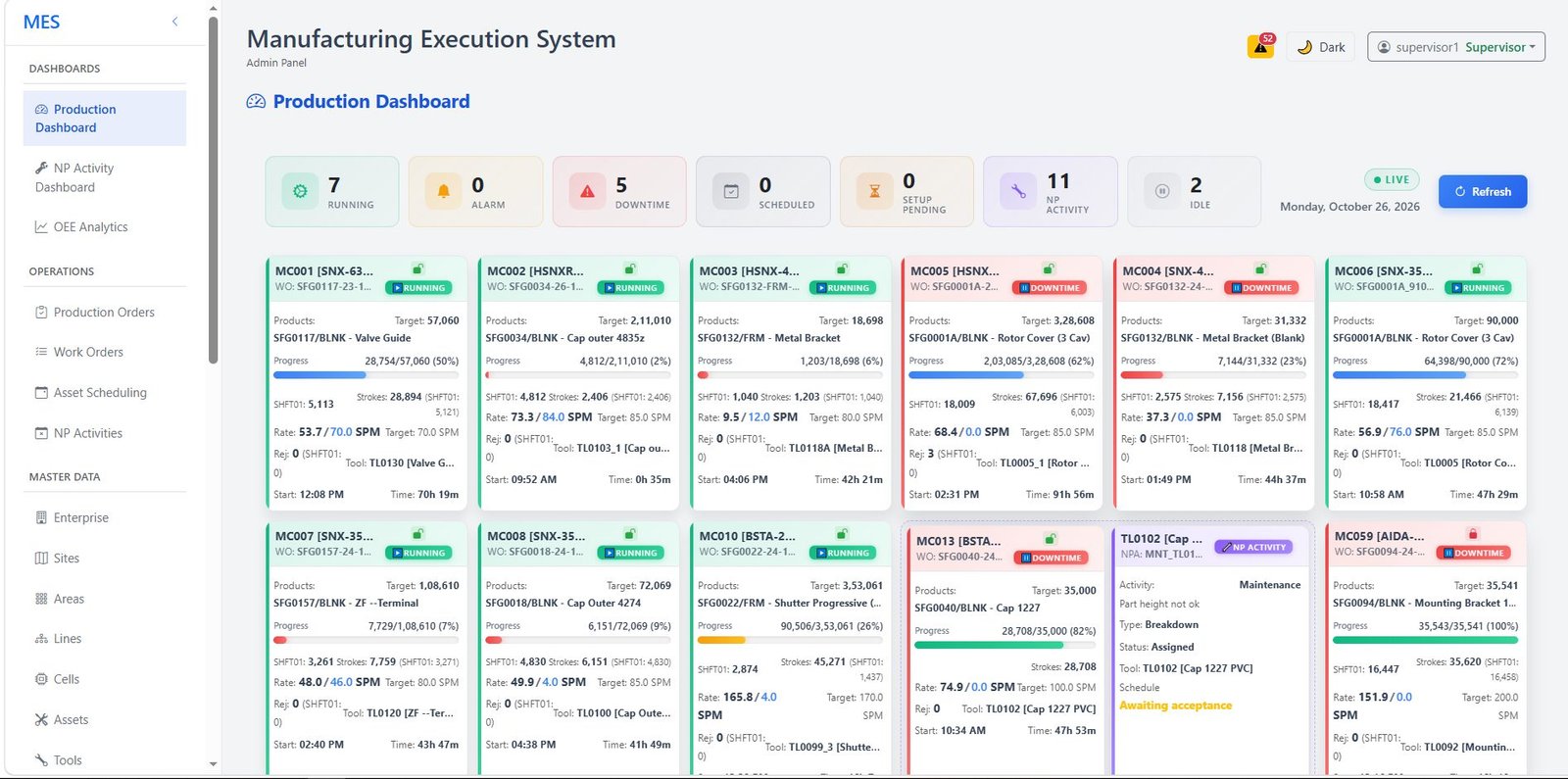
What You Get
Real-time machine monitoring
Live status for every press and line: running, idle, stopped or in changeover. Spot problems as they happen and cut downtime.
Downtime and OEE tracking
Automatic capture of stop reasons, availability, performance and quality, so you can see where output is being lost.
Press force and condition alerts
Sensor-based alerts flag abnormal tonnage, misalignment or temperature before they damage tooling or scrap parts.
Production planning and job tracking
Track each job against its target quantity and cycle time. Operators see what to run next; supervisors see where each order stands.
Quality and traceability
Record part counts, rejects and process data against each batch, so any part can be traced to its press, shift and settings.
ERP integration
Share production data with your ERP so planning, inventory and costing use real numbers instead of estimates.
Why Stamping Plants Choose IIoT MES
- Higher throughput: less unplanned downtime and tighter press cycle times.
- Lower scrap: early warnings on force, alignment and temperature protect tooling and parts.
- Safer operation: operator presence and motion tracking, plus emergency-stop integration with real-time alerts.
- Remote visibility: custom dashboards and secure remote access, configured for your part geometry and production volume.
- Built for stamping: designed around feeders, decoilers, straighteners and conveyors, not adapted from generic software.
How It Works
Connect
We install sensors and gateways on your presses and line equipment.
Collect
Machine and process data flows to a secure platform, on-site or in the cloud.
Visualise
Live dashboards, alerts and shift reports are set up for your plant.
Improve
Your team uses the data to cut downtime, reduce scrap and plan better.
Who It Is For
Metal stamping and press shops, battery can and enclosure manufacturers, automotive and electrical component suppliers, and any plant running automated stamping lines that wants to move from manual tracking to live data.
Frequently Asked Questions
Can it work with our existing presses?
Yes. We connect to existing machines using sensors and controllers, so you do not need to replace equipment. [Confirm with your technical team.]
Does it integrate with our ERP?
Yes. MES data can be shared with ERP systems for planning, inventory and costing.
Can we see data remotely?
Yes. Dashboards can be accessed securely from approved devices, on-site or remote.
How long does implementation take?
[Typical timeline, e.g. 4 to 8 weeks], depending on the number of machines and integrations.
Do you provide training and support?
Yes. Installation, commissioning and operator training are part of our service, along with ongoing support.
See your plant’s real performance, live.
Talk to our team about a demo for your stamping lines.
Request a DemoTransforming Sheet Metal Stamping with IIoT
Industrial Internet of Things (IIoT) is revolutionizing the sheet metal stamping industry by enabling smarter, safer, and more efficient manufacturing. At Crimson Manufacturing Solutions, we integrate IIoT technologies to help manufacturers unlock new levels of productivity, customization, and operational insight.
Increased Efficiency
- Real-time machine monitoring reduces downtime and improves throughput.
- Data-driven insights optimize press cycle times and material usage.
- Automated alerts and diagnostics minimize manual intervention.
Enhanced Flexibility and Customization
- Modular IIoT systems adapt to various stamping setups—feeders, decoilers, straighteners, and conveyors.
- Custom dashboards allow operators to configure workflows based on part geometry and production volume.
- Remote access enables quick reconfiguration for new jobs or client-specific requirements.
Improved Safety
- Sensor-based monitoring detects anomalies in press force, alignment, and temperature.
- Emergency stop systems are integrated with real-time alerts and predictive triggers.
- Operator presence and motion tracking reduce risks in high-speed environments.
Digitalizing the Manufacturing Process
- Cloud-connected platforms centralize data from stamping lines, enabling centralized control and analytics.
- Integration with ERP and MES systems ensures seamless production planning and traceability.
- Digital twins simulate stamping operations for process optimization and training.
Predictive Maintenance
- Vibration, temperature, and current sensors monitor equipment health continuously.
- AI-driven analytics predict wear and tear on dies, motors, and actuators.
- Maintenance schedules are dynamically adjusted based on usage patterns and risk levels.
Automated Visual and Video Inspection
- High-resolution cameras and AI algorithms detect surface defects, misalignments, and burrs.
- Real-time video feeds allow supervisors to monitor quality across multiple lines.
- Inspection data is logged for compliance, traceability, and customer reporting.
Business Impact
- Reduced scrap rates and rework costs.
- Faster turnaround times and improved customer satisfaction.
- Enhanced transparency and accountability across the supply chain.
Why Crimson Manufacturing Solutions?
We specialize in IIoT integration for sheet metal stamping, offering:
- End-to-end connectivity for press machines and peripheral equipment.
- Customizable dashboards and analytics tailored to your production goals.
- Proven expertise in automation, control panels, and industrial communication protocols.
Let us help you future-proof your stamping operations with intelligent connectivity and actionable insights.
Understanding OEE Metrics
Overall Equipment Effectiveness (OEE) is a key performance metric used in manufacturing to measure how effectively a machine or production line is utilized compared to its full potential during scheduled production time. It combines three critical factors: Availability, Performance, and Quality.
- Availability measures the percentage of scheduled time that the equipment is actually running and not down due to breakdowns or other stoppages.
- Performance assesses whether the equipment is running at its ideal speed during the available time, accounting for slow cycles or minor stops.
- Quality reflects the proportion of good parts produced versus total parts, highlighting defects and rework.
An OEE score of 100% means the equipment is producing only good parts, at maximum speed, without any downtime. Lower scores indicate losses in one or more areas, helping manufacturers identify and target specific inefficiencies to improve overall productivity.
Using OEE metrics allows manufacturers to systematically reduce waste, optimize machine utilization, and enhance production quality, making it an essential tool for continuous improvement in industrial operations.
In the sheet metal stamping industry, integrating OEE tracking with IIoT sensors and real-time dashboards empowers operators to monitor equipment health, detect anomalies early, and optimize production processes dynamically, leading to enhanced productivity and reduced downtime.
Quality Control: Automated Optical Inspection (AOI) and Computer Vision (CV)
Ensuring high quality in sheet metal stamping is critical for meeting customer specifications and reducing defects. Automation technologies like Automated Optical Inspection (AOI) and Computer Vision (CV) play a vital role in elevating quality control.
- Automated Optical Inspection (AOI): AOI systems use high-resolution cameras and controlled lighting to capture detailed images of stamped parts. These systems detect surface defects, dimensional inaccuracies, and critical features such as holes and threads in real-time, ensuring only conforming parts proceed further in the production line.
- Computer Vision (CV): Leveraging artificial intelligence and machine learning, CV systems analyze images to identify subtle defects and verify part orientation, placement, and assembly correctness. For example, dual-camera CV setups can inspect both sides of a component, enhancing inspection accuracy and enabling traceability through QR code printing.
Improving Traceability and Accountability with IIoT
IIoT technologies enhance traceability and accountability throughout the manufacturing process by integrating data capture and tracking systems.
- Bin/Pallet Management: Using metal QR codes scanned by mobile devices, this system tracks pallets from production through shipment, ensuring accurate inventory management and delivery verification.
- Part Management System: QR codes on parts stored in racks enable precise inventory control, reducing errors and improving operational efficiency.
Together, these systems provide comprehensive visibility into production status, inventory movement, and quality assurance, empowering manufacturers to maintain high standards and respond swiftly to issues.
What We Offer
Why Choose Our
IIoT Integration
End-to-End IIoT Expertise
From sensors to cloud platforms, we handle every stage of integration.
Industry-Focused Solutions
Designed for sectors like automotive, electronics, heavy machinery, and more.
Secure & Scalable Architecture
Built on secure, scalable platforms ready to grow with your business.
Key Capabilities
- Equipment Monitoring & Health Tracking
- Remote Machine Diagnostics
- Energy Management
- Inventory & Asset Tracking
- Automated Alerts & Threshold Notifications
- Custom Dashboards & Reporting
- Integration with ERP, MES & SCADA Systems


